
Introduction
Mindful automation for creators starts with a simple question: what do we lose when we automate everything?
In today’s digital landscape, platforms and influencers push a single, deafening message: automate everything. Build enough bots, zap enough workflows, schedule enough posts, and they promise a version of “passive freedom.” Yet for many creators, that promise rings hollow. The more work we hand over to machines, the more we drift from the work that once energized us. We begin to feel less like artists and more like technicians managing a factory.
At AlohaDigitalWorks, we follow a different path. Instead of choosing between hustle until burnout or automation until disappearance, we practice mindful automation for creators through what we call the Creative Ecosystem. This philosophy treats a business and its creative output not as machines to optimize for speed, but as living environments to tend for long-term health. True efficiency is not about how fast you move. It is about how much clarity you preserve while moving. Mindful automation does not remove the human from the loop; it protects the human within it.
Section 1: Surface Meaning — The Trap of “Efficiency for Efficiency’s Sake”
At first glance, automation appears to be a simple utility. It is a tool for saving time. The surface-level understanding of automation, the one peddled by productivity coach and software companies, is purely transactional. It suggests that time is a generic commodity, and any second saved is a victory. Under this framework, the goal is to reduce every process to a repeatable script. Automate email replies where possible. Use AI to draft captions. Schedule a year of content in an hour when efficiency serves clarity.
However, this surface-level view ignores the texture of the work. It treats a heartfelt response to a reader the same way it treats an invoice generation. When we view automation solely through the lens of speed, we fall into the trap of “efficiency for efficiency’s sake.” We begin optimizing tasks that perhaps shouldn’t exist at all, or we automate interactions that actually require our presence to be meaningful.
We see this manifested in the “zombie brands” of social media, accounts that post relentlessly but feel entirely vacant. The lights are on, the machinery is running, but there is no one home. This is the danger of stopping at the surface meaning of automation. We confuse output with impact. We assume that because we are visible, we are connecting. But in a creative ecosystem, visibility without resonance is just noise. The surface meaning tells us that automation is a lever for volume. But if we pull that lever without intention, we are merely amplifying our own absence. We are building a hollow shell that looks like a business but feels like a ghost town.
Section 2: Deeper Meaning — The Psychology of Disconnection
Beneath the promise of time savings lies a more complex psychological reality. Each time we automate part of the creative process, we loosen a small thread of connection to our work. Sometimes that distance is healthy. Automation can free us from administrative tasks like data entry or file management.
At other times, however, automation cuts into the connective tissue that gives work its meaning.
A deeper interpretation of automation reveals a quiet crisis of agency. When creators use AI to generate opinions they have not formed or stories they have not lived, they are not just outsourcing tasks. They are outsourcing their voice. This leads to a subtle burnout, not from overwork, but from under-meaning. The exhaustion comes from watching a version of yourself perform while you remain detached.
Within the AlohaDigitalWorks Creative Ecosystem, we interpret this tension as a signal. The creator must remain the governing architecture of the system. Any workflow that outpaces a creator’s nervous system breaks down. Any system that produces more content than the creator can stand behind is dishonest.
Automation should act as a container, not the content itself. It should hold space, manage logistics, and create boundaries. Inside that container, the human work remains fluid, organic, and imperfect.
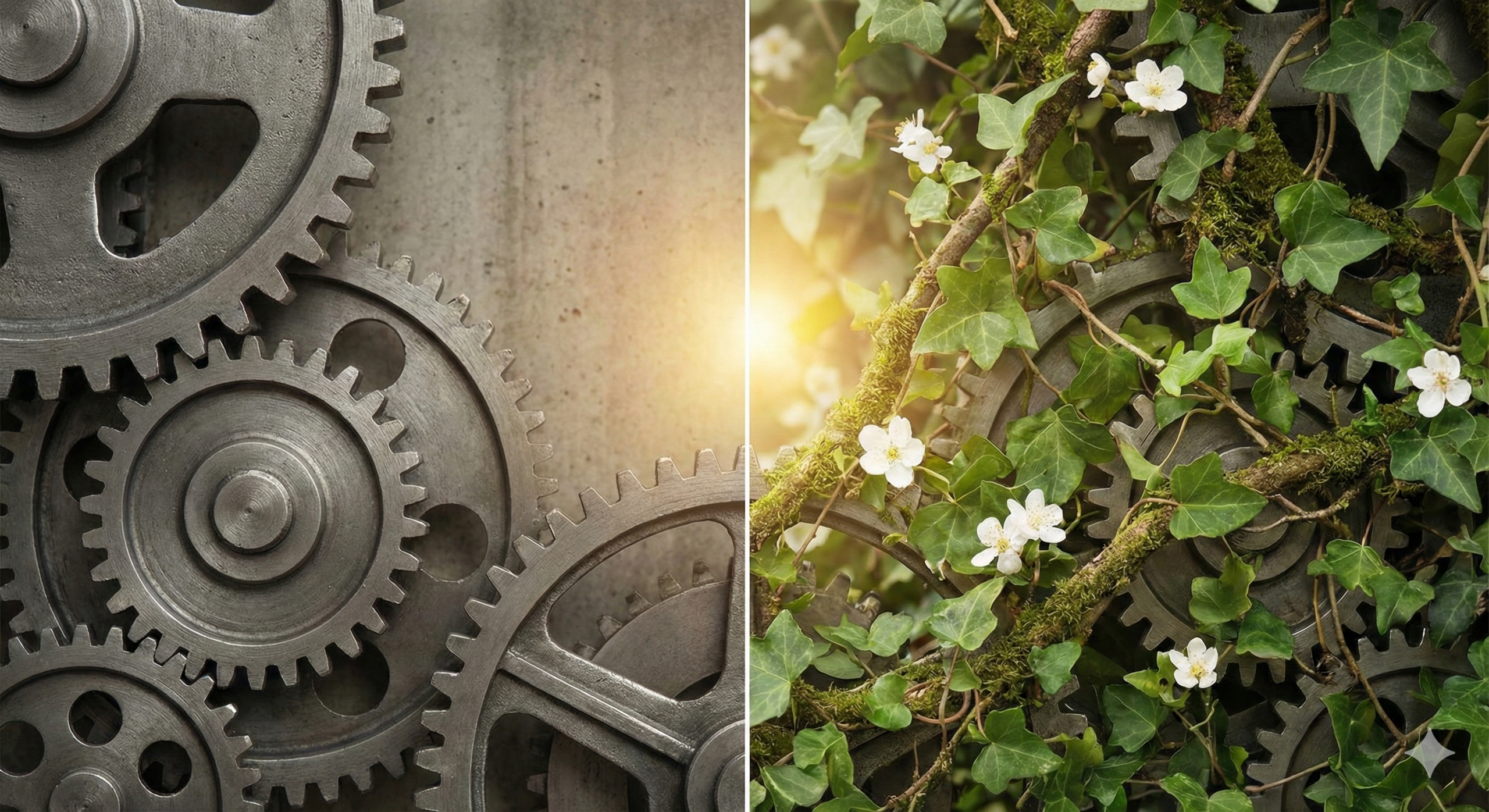
This is a shift from the metaphor of the factory to the metaphor of the garden. In a garden, automation handles irrigation. Growth cannot. Technology creates the conditions for flourishing, but the season still arrives in its own time.
Section 3: Applied Meaning — 5 Principles from the Creative Ecosystem
How do we move from this philosophical garden to the practical reality of running a digital business? We apply the following five principles from the AlohaDigitalWorks Creative Ecosystem. These are the guideposts for building systems that serve the soul.
1. Identity-First, System-Second
Automation must always be a reflection of your identity, never a replacement for it. Before you automate a workflow, you must understand the intent behind it. Does this email sequence sound like you? Does this onboarding process make the client feel the way you would make them feel in person? If the system obscures your unique signature, it is failing, no matter how efficient it is. We build the system around the creator’s voice, ensuring that every automated touchpoint carries the DNA of the brand.
2. The Human-in-the-Loop (HITL) Mandate
We never fully abdicate responsibility to the machine. In the ADW ecosystem, we practice the HITL mandate: critical junctions must have human oversight. We might use AI to draft, structure, or brainstorm, but a human must review, refine, and approve the final output. This approach protects what machines cannot replicate: empathy, nuance, and cultural context. Automation supports the human; it does not evict them.
3. Cyclical Stewardship
Traditional automation is linear and relentless; it runs 24/7. But humans are cyclical. We have seasons of high energy and seasons of dormancy. Mindful automation respects these cycles. Our systems pause, adjust, or slow down. Content follows seasons, not pipelines. Automation supports rest through repurposing, not the illusion of nonstop output.
4. Intentional Friction
This is counter-intuitive. Usually, we try to remove all friction. But in a mindful ecosystem, we introduce intentional friction at moments of high value. Sometimes we choose not to automate a “thank you,” preferring to write it by hand. We may skip auto-posting everywhere in favor of messages shaped for their context. We protect friction that creates intimacy and automate only friction that creates waste.
5. Ecosystem Health over Factory Output
We measure success not by output volume, but by the health of the ecosystem. When a system produces high volume while the creator feels stressed, anxious, and disconnected, the ecosystem turns toxic. We prioritize the health of the creator as the primary asset. If automation reduces stress and increases clarity, it is good. We discard anything that increases anxiety about “keeping up the feed.”
Practical Examples
Let’s look at how these principles manifest in the daily life of a mindful creator.
Scenario A: The Newsletter Writer
The Factory Approach: The writer uses an AI tool to scrape news, summarize it, and auto-send a newsletter every morning at 8 AM. They never look at it. The open rates are okay, but replies are zero. The writer feels no connection to the audience.
The Creative Ecosystem Approach: The writer uses automation to collect relevant articles into a dashboard (Principle 1: Identity-First). They use AI to summarize key points, but then they sit down for 30 minutes to write a personal introduction and synthesize the links (Principle 2: HITL). They use an automation to handle the subscription management and tagging (removing low-value friction), but they personally reply to every email response (preserving high-value friction).
Scenario B: The Visual Artist
The Factory Approach: The artist uses a scheduler to blast the same image to Instagram, LinkedIn, Pinterest, and Twitter simultaneously with generic hashtags.
The Creative Ecosystem Approach: The artist uses automation to resize their artwork for different platforms (Stewardship). They schedule the posts, but they write a specific caption for LinkedIn about the business of art, and a specific caption for Instagram about the emotion of art (Principle 4: Intentional Friction). They schedule these posts to go out only 3 days a week, honoring their need for deep work days where they are offline entirely (Principle 3: Cyclical Stewardship).
Scenario C: Client Onboarding
Instead of a cold, instant PDF download, the system sends a warm welcome email (automated) that asks a specific question. When the client replies, the creator answers personally. The contract and invoicing are fully automated (low-value tasks), but the strategy call is scheduled with ample buffer time for the creator to prepare mentally (Ecosystem Health).
Conclusion
Moving beyond automation requires a shift in mindset. It demands that we stop asking “What can I automate?” and start asking “What must I protect?” The AlohaDigitalWorks Creative Ecosystem is not a rejection of technology; it is a maturation of our relationship with it. It is the decision to stop acting like a machine and start acting like a gardener.
By applying these five principles, Identity-First, Human-in-the-Loop, Cyclical Stewardship, Intentional Friction, and Ecosystem Health, we reclaim our agency. We build businesses that are resilient, authentic, and sustainable. We use the machine to carry the heavy load, so that we have the strength left to carry the meaning.
If you are feeling the weight of the digital factory, remember that you have the power to redesign the blueprint. You can dismantle the assembly line and plant a garden. It takes more intention, yes. It requires more mindfulness, absolutely. But the fruit it bears is the only kind that truly nourishes connection, clarity, and a body of work that is undeniably yours.
References:
- Mindful Automation Manifesto. (External Authority on Ethical Systems)
- Self-Determination Theory (Ryan & Deci): Psychological backing for autonomy and relatedness in work.
- Cal Newport, “Digital Minimalism”. (Cultural Context on Focus)
- The AlohaDigitalWorks Creative Ecosystem: A Decision Journal for Mindful Creators (Internal)
- ADW Guide to Slow Business. (Internal)
- The Mindful Automation Audit. (Internal)

Leave a Reply